
Why families keep choosing in-house clear aligners comes down to three things: speed, oversight, and value. When your aligners are planned and produced inside the practice, there’s no waiting on an outside lab and no guessing who reviewed your case. Dr. Danzer does. Here’s how the process works and what it means for your family.
What Are In-House Clear Aligners?
In-house clear aligners are custom trays planned and produced under your orthodontist’s direct supervision, inside the practice. Dr. Danzer maps each tooth movement digitally, then the trays are fabricated locally instead of shipped out to a third-party lab. You get the same staged tooth movement as name-brand systems, with faster turnaround and hands-on oversight.
That last part matters. Mail-order and DIY aligner companies ask you to take your own impressions at home, then a remote reviewer signs off on a plan without ever examining your teeth, gums, or bite in person. No X-rays. No follow-up visits. In-house aligners flip that completely: every tray traces back to a licensed orthodontist who has actually looked in your mouth.
The material itself is familiar. In-house aligners use medical-grade, BPA-free thermoplastic and the same staged movement principles used across clear aligner treatment. What changes is who controls the design and how quickly changes happen.
You’ll see these systems called by a few different names: doctor-directed aligners, practice-branded aligners, or in-office aligner systems. At Danzer Orthodontics, ours are called N-Line aligners. Same idea, friendlier name.
How In-House Clear Aligner Treatment Works, Step by Step
In-house clear aligner treatment at Danzer Orthodontics starts with a free consultation and a digital 3D scan, followed by a customized treatment plan designed by Dr. Danzer. Your trays are fabricated, delivered, and worn 20 to 22 hours a day. Short progress checks keep things on track, and retainers protect the finished result.
Here’s the full process:
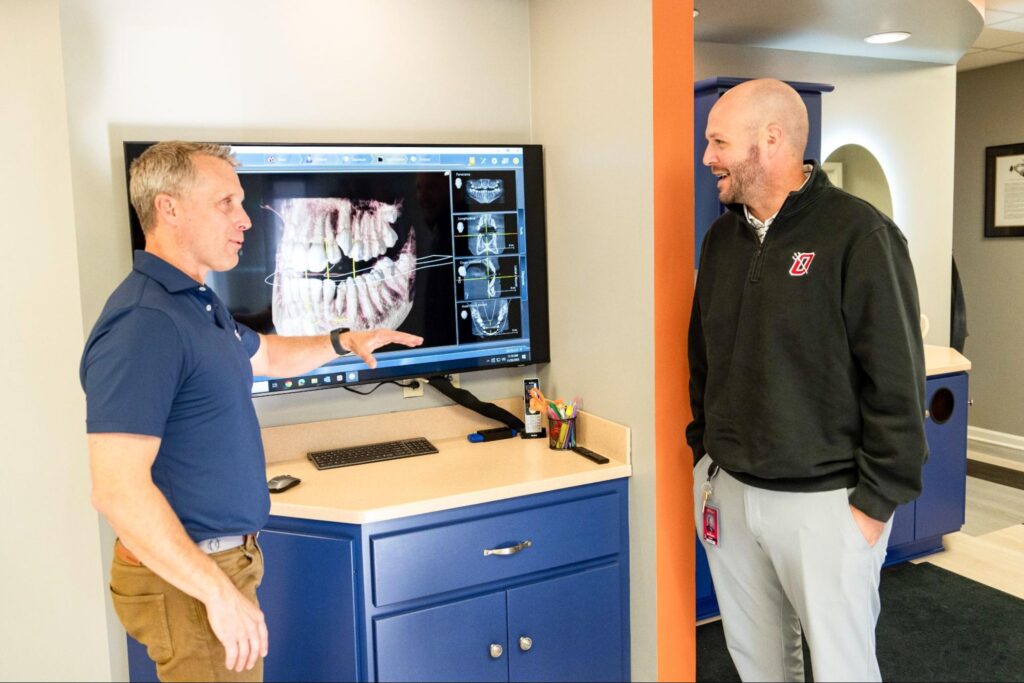
- Free consult and digital scan. We start with photos, X-rays, and a digital 3D intraoral scan. No trays of putty, no gagging, no do-overs. The scan takes just a few minutes.
- Dr. Danzer designs your plan. Using the scan, he sequences every tooth movement and previews your finished result before a single tray is made. You’ll see where your smile is headed.
- Aligners are made and delivered. Because production happens in-house, families typically skip the shipping and lab queue delays that come with outside fabrication.
- You wear them 20 to 22 hours daily. Trays come out for meals, brushing, and flossing. You’ll switch to the next set on the schedule Dr. Danzer gives you.
- Progress checks and refinements. Visits are short. If a tooth is being stubborn, adjustments to attachments or a refinement tray can often be handled quickly instead of waiting weeks on a re-order.
- Retainers keep it that way. Teeth like to drift back toward where they started. Retainers are the final, non-negotiable step of treatment. Dr. Danzer and the team will walk you through how many hours a day to wear yours at the start, how that schedule tapers over time, and when to have them checked or replaced.
Why Families Keep Choosing In-House Aligners
Families stick with N-Line aligners for practical reasons, not marketing ones. When the planning, production, and follow-up all live under one roof, the whole experience gets simpler.
- Faster turnaround. Replacement trays, refinements, and mid-course changes don’t sit in a third-party lab queue. That’s often the difference between waiting weeks and getting back on schedule quickly.
- Direct doctor accountability. Every tray traces back to Dr. Danzer, not an algorithm or a reviewer you’ll never meet. He designed the plan, so he knows exactly what each tray is supposed to accomplish.
- Fewer, shorter visits. Check-ins are quick and spaced out, which is a relief when you’re juggling school pickups, practice schedules, and work meetings.
- Better value. Removing outside lab markup keeps the fee lower without cutting corners on materials or oversight. That’s people-first finances in action.
- Flexibility mid-treatment. Teeth don’t always cooperate on paper. If your case needs a shift, Dr. Danzer can adjust the plan, add attachments, or combine aligners with braces without restarting from scratch.
- One office for the whole household. Teens and adults can be treated side by side, under one practice, with one team who knows your family by name. Orthodontic solutions for every age, in one place.
Some families drive well over an hour to be seen here, which tells you something about how much the in-person relationship matters.
In-House Aligners vs. Invisalign vs. Mail-Order Aligners
All three move teeth with clear plastic trays. What separates them is who’s watching, how fast changes happen, and what kinds of cases each can handle.
| N-Line Aligners (In-House) | Invisalign | Mail-Order Aligners | |
|---|---|---|---|
| Doctor oversight | Direct, in person, every visit | Direct, in person, every visit | Remote review only |
| In-office exam & X-rays | Yes | Yes | No |
| Turnaround for new trays | Typically fastest (made on site) | Outside lab production | Shipped to your home |
| Typical fee | Often lower than Invisalign, since there’s no outside lab markup | Higher brand and lab fee | Lowest upfront |
| Case complexity | Mild to moderate; hybrid options available | Mild through complex | Very limited |
| Refinements | Handled in-house, often same visit | Ordered through the lab | Limited or extra cost |
| Retainers & follow-up | Included in your customized treatment plan | Included in your customized treatment plan | Usually sold separately |
N-Line aligners shine for crowding, spacing, minor rotations, and relapse after braces. Dr. Danzer controls the design start to finish, so course corrections happen fast.
Invisalign brings a massive treatment database and SmartTrack material, which gives it an edge on complex bites and larger movements. Danzer Orthodontics offers it as well.
Mail-order aligners win on sticker price and nothing else. Without an exam, X-rays, or in-person monitoring, gum and bone conditions can go unnoticed and relapse risk climbs. The American Association of Orthodontists has publicly cautioned consumers about direct-to-consumer orthodontics for exactly this reason, pointing to the absence of an in-person diagnosis and ongoing supervision by a licensed orthodontist.
Bottom line: both in-office options include real, hands-on monitoring. Mail-order doesn’t.
What Affects the Cost of Clear Aligner Treatment
Clear aligner cost isn’t one flat number. It depends on how much your teeth need to move, how long treatment runs, how many trays your case requires, and whether extras like attachments or hybrid braces come into play. In-house production removes outside lab markup, which is why doctor-directed aligners often cost less than name-brand systems.
As a general benchmark, clear aligner treatment tends to land in the same overall range as braces, with shorter, simpler cases at the low end and longer, more involved cases at the high end.
| Cost Factor | Why It Matters |
|---|---|
| Case complexity | Bigger movements need more trays and more planning time |
| Treatment length | Longer cases mean more trays and more progress checks |
| Refinement rounds | Some smiles finish in one round; others need a second set |
| Attachments or IPR | Small tooth-colored anchors or slight enamel reshaping add steps |
| Hybrid treatment | Combining aligners with braces changes the overall fee |
| Retainers & replacements | Ask what’s bundled into your quote and what’s billed separately |
A few things work in your favor. Many dental plans include a lifetime orthodontic benefit that applies to aligners the same way it applies to braces. FSA and HSA dollars typically cover orthodontic care as well. And monthly payment options through Danzer Orthodontics are built around your family’s budget, not the other way around.
You’ll get a clear, itemized number at your free consultation. No surprises later.

Who Is a Good Candidate for In-House Clear Aligners?
Most people with mild to moderate alignment concerns make excellent candidates. Aligners handle crowding, spacing, minor rotations, and relapse after braces particularly well, which covers a large share of the cases we see.
Good candidates usually check these boxes:
- All permanent teeth have erupted. Aligners work best once the adult dentition is in place.
- Gums and teeth are healthy. Active decay or gum disease gets addressed first.
- Compliance is realistic. Trays only work when they’re in your mouth 20 to 22 hours a day. This is the single biggest predictor of success.
- The bite issue is within range. Significant bite discrepancies may call for braces, elastics, or a hybrid approach.
Teens with solid routines do great, especially when they’re motivated by a discreet option. Adults make up a growing share of clear aligner cases, and many of them are people who had braces years ago and watched their teeth drift.
If your case falls outside the aligner sweet spot, Dr. Danzer will tell you straight. Sometimes metal braces or clear braces are simply the better tool, and honesty beats an upsell every time.
One more thing, and it’s worth repeating: candidacy can’t be confirmed from a photo or an at-home kit. It takes records, X-rays, and a digital scan reviewed by an orthodontist in person.
It also helps to know who’s reading that scan. Dr. Joe Danzer earned his dental degree from the University of Kentucky and completed his orthodontic residency at Vanderbilt University. He’s affiliated with the American Dental Association and the American Association of Orthodontists, and he keeps up with continuing education so your family benefits from current techniques and technology. The practice welcomes patients of all ages, and every visit starts with a free consultation: digital scan, honest answers, clear pricing, no pressure. See what clear aligners could do for your smile with a free consult alongside your friendly neighborhood orthodontic experts.

Frequently Asked Questions About In-House Clear Aligners
How long does clear aligner treatment take?
Most clear aligner cases run somewhere in the range of 6 to 18 months, though simple cases can finish faster and complex ones take longer. Your timeline depends on how far your teeth need to travel and how consistently you wear your trays. Dr. Danzer will give you a realistic estimate at your free consult, after he’s reviewed your scan and X-rays.
Are in-house aligners as effective as Invisalign?
For mild to moderate crowding, spacing, and relapse cases, yes. Both use medical-grade thermoplastic, both rely on the same staged movement principles, and both are directed by an orthodontist who examines you in person. Invisalign holds an edge on complex bite corrections, which is why Danzer Orthodontics offers both and matches the system to your case.
Do clear aligners hurt?
You’ll feel pressure and mild soreness for a day or two after switching to a new tray. That’s the aligner doing its job. Most families describe it as tightness rather than anything sharp, and it fades quickly. Since there are no wire adjustments, you skip the longer chair time and the soreness that follows.
How many hours a day do I have to wear them?
Plan on 20 to 22 hours every day. Trays come out for meals, drinks other than water, brushing, and flossing. The rest of the time, including while you sleep, they stay in. Falling short on wear time is the most common reason aligner treatment stalls.
Can teenagers use clear aligners?
Absolutely. Teens are strong candidates once their permanent teeth are in, and many prefer aligners for sports, band, and photos. Some teen aligners include compliance indicators that fade with wear, giving parents an easy visual check. Dr. Danzer will talk honestly with your teen about what consistent wear requires.
What happens if I lose or break an aligner?
Call the practice right away and hold onto your previous tray. Depending on where you are in the sequence, we may have you move to the next set early or wear the prior one while a replacement is made. This is where in-house production really pays off, since replacement trays don’t have to wait on an outside lab.